
Case Study: Developing the next generation data collection strategies for X-ray chemical imaging
Companies involved:
Finden Ltd, University College London, ESRF
Challenge:
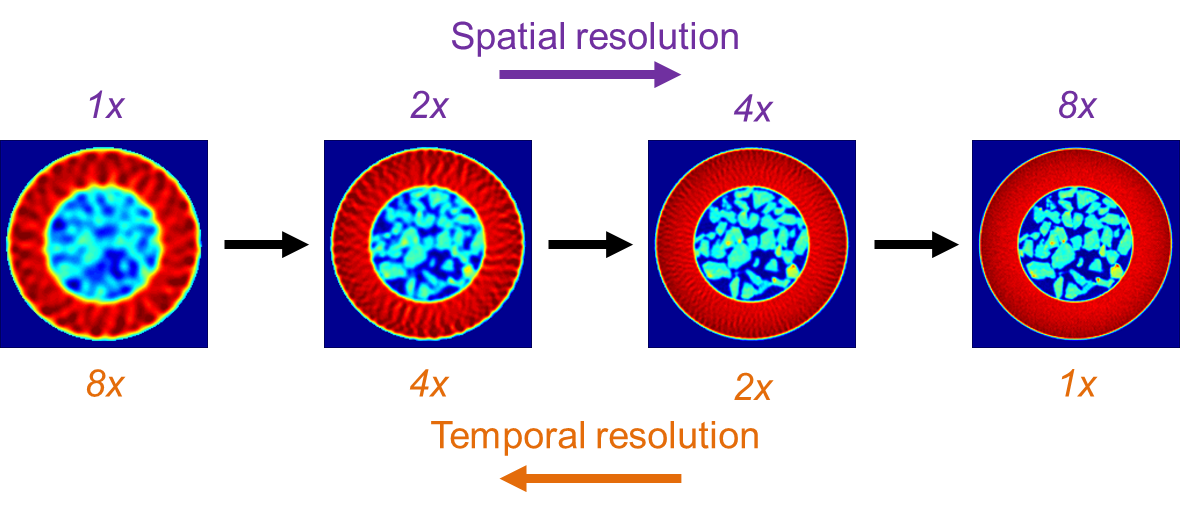
In dynamic X-ray diffraction computed tomography (XRD-CT) experiments, a number of datasets is carried out to yield a series of XRD-CT “slices” showing the spatial changes in chemistry/physical form within a sample over time. However, the spatial and temporal resolutions in such experiments are fixed during collection by choice of acquisition parameters and these resolutions were traded off against one another. High spatial resolution can be obtained but with low temporal resolution and vice-versa. The risk here is that chemical / physical changes could occur during the collection of a single XRD-CT slice yielding only a partial understanding of the relationship between spatial composition and time.
Sample:
Mn-Na-W/SiO2 packed bed reactor.
Solution:
We developed a new data collection strategy, termed interlaced XRD-CT, which allows, post experiment, choice between temporal and spatial resolution. This strategy enables time resolved studies on comparatively short time scales, alternatively allowing for improved spatial resolution if the system under study, or components within, appear to be unchanging. Additionally, this method enables post collection tuning between statistical, temporal and spatial resolutions.
Benefits:
Finden often works with leading companies and scientists to perform in situ experiments studying functional materials and devices. We are continuously developing new data collection strategies in order to obtain the best possible X-ray imaging data the fastest way. For example, the interlaced scanning approach can be also applied to other pencil beam tomographic techniques, like X-ray fluorescence computed tomography (XRF-CT), X ray Absorption Fine Structure computed tomography (XAFS-CT) and tomographic Scanning Transmission X-ray Microscopy (STXM).
Further reading:
Interlaced X-ray diffraction computed tomography A. Vamvakeros, S.D.M. Jacques, M. Di Michiel, P. Senecal, V. Middelkoop, R.J. Cernik and A.M. Beale. Journal of Applied Crystallography (2016) 49, 485.

The research project receives funding from the European Community‘s Framework Programme for Research and Innovation Horizon 2020 (2014-2020) under grant agreement no. 679933.
Read more about our team and further publications.