
 Case Study: Unravelling the spatial dependency of the complex solid-state chemistry of Pb in a paint micro-sample from Rembrandt’s Homer using XRD-CT
Companies involved:
Finden Ltd, UCL, Rijksmuseum in Amsterdam, Diamond Light Source, Mauritshuis in The Hague
Challenge:
The surface of many Old Master paintings has been affected by the appearance of whitish lead-rich deposits, which are often difficult to fully characterise, thereby hindering conservation. A paint micro-sample from Rembrandt’s Homer was imaged using X-ray Diffraction Computed Tomography (XRD-CT) in order to understand the evolving solid-state Pb chemistry from the painting surface and beneath.
Sample:
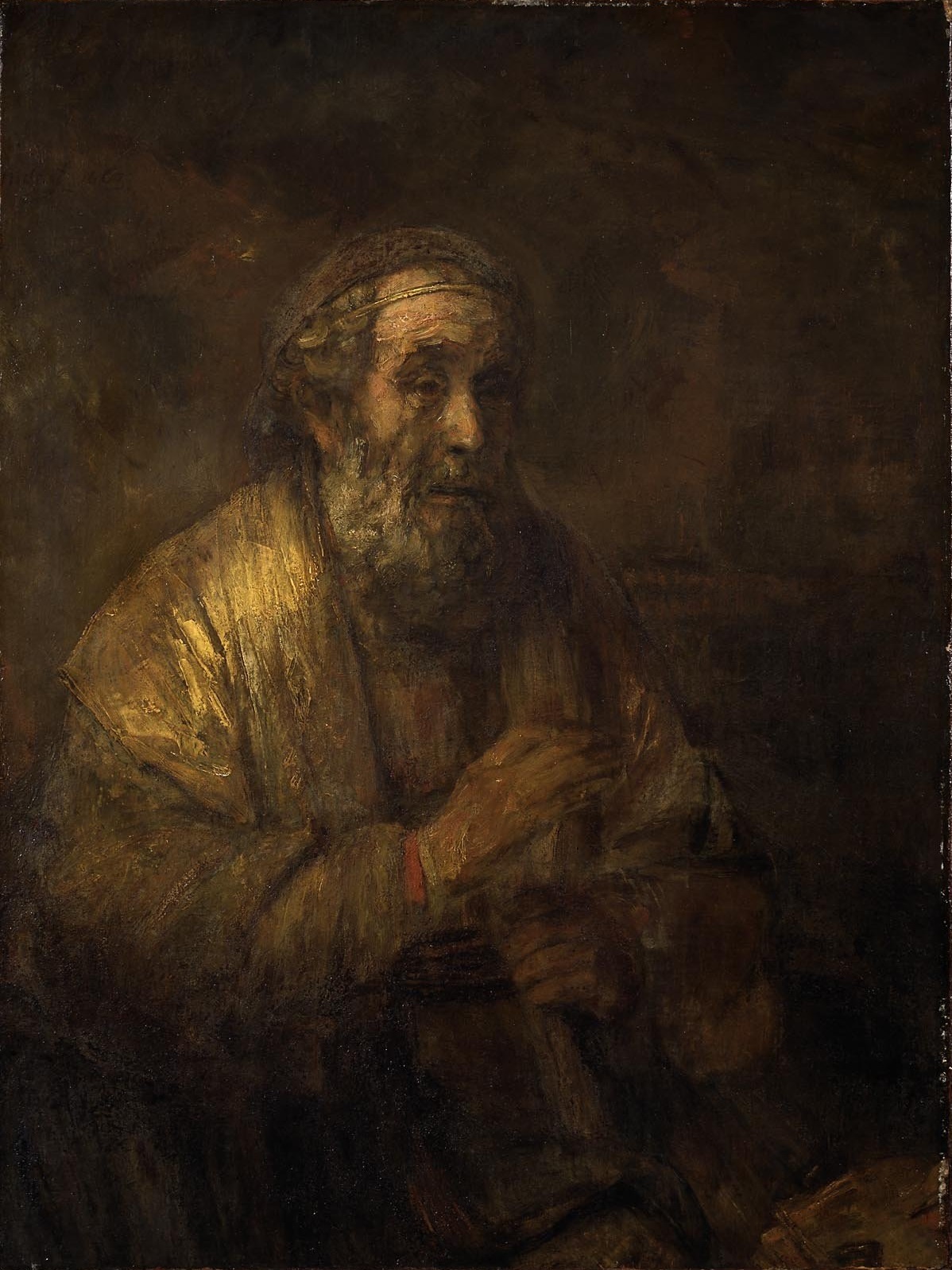
Rembrandts Homer 1663, credit Mauritshuis. A carefully prepared a micro-sample of the damaged paint <100 micron in size was imaged at the synchrotron.
Solution:
The surface crust was identified as a complex mixture of lead sulfates. From the S:Pb ratios throughout the paint layer, we can conclude that S is from an external source in the form of SO2, and that the nature of Pb–SO4 product is dependent on the degree of diffusion/absorption of SO2 into the paint layers.
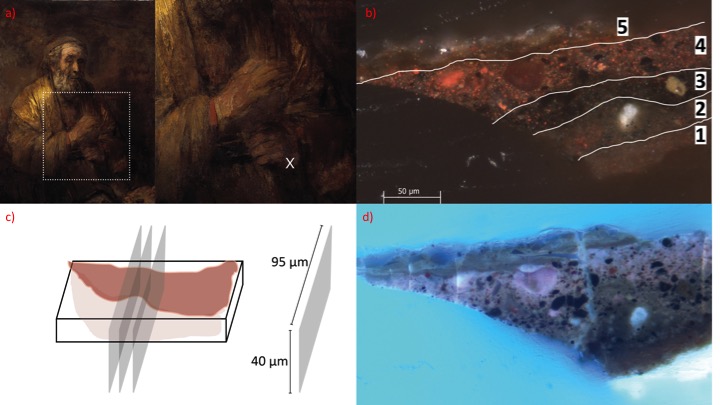
Fig. 1 Rembrandt van Rijn, Homer, 1663, oil on canvas, 107 × 82 cm, Mauritshuis, The Hague. Paint cross-section (X) taken from Homer’s left hand (a), optical microscope showing layers of paint (b), schematic of paint fragment embedded in resin with dimensions and regions imaged (c), and UV (d). Chem. Commun., 2019, Advance Article
Benefits:
A clear understanding of the nature of the surface crust and underlying reaction processes is critical for guiding conservation strategies. XRD-CT has been able to identify for the first time all of the different crystalline structures present, giving a clear picture as to the nature of the Pb deposits, not just on the surface of the painting, but through the whole layer. This helped to identify the historical source and mechanism of formation of the deposits, and to provide reassurance that no further deposits would form on this or similar paintings.
Further reading:
Unravelling the spatial dependency of the complex solid-state chemistry of Pb in a paint micro-sample from Rembrandt’s Homer using XRD-CT. Stephen W. T. Price, Annelies Van Loon, Katrien Keune, Aaron D. Parsons, Claire Murray, Andrew M. Beale and J. Fred W. Mosselmans. Chemical Communications, 2019, 55, 1931 – 1934
Press:
The Telegraph, “Old Master paintings shown to be ‘crusting over’ by microscope 10 billion times brighter than the Sun.”
Physics World website, “Synchrotron study could help better preserve Old Masters”
Diamond Light Source website, “Saving Rembrandt for future generations”
UCL website, “Saving Old Master paintings with chemistry”
Read more about our team and further publications.