
New solution to the parallax problem in X-ray scattering/diffraction experiments
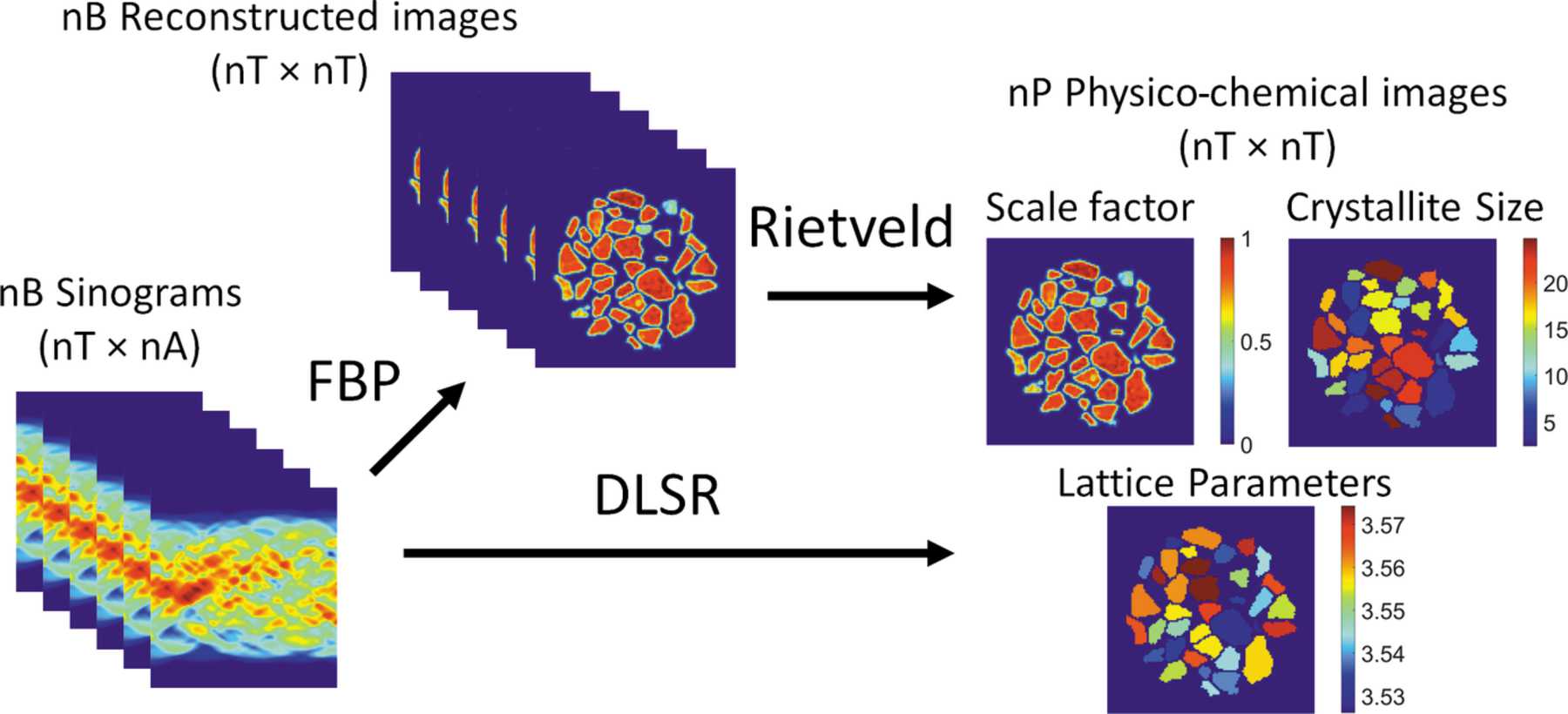 Our scientists’ new work on finding a solution to the parallax problem in X-ray scattering/diffraction experiments has been published in a new paper, “DLSR: a solution to the parallax artefact in X‐ray diffraction computed tomography data,” published in the Journal of Applied Crystallography.
The work was performed in collaboration with the creator of the TOPAS software Alan Coelho, DESY, UCL Chemistry, ESRF and SciML.
A new tomographic reconstruction algorithm is presented, termed direct least‐squares reconstruction (DLSR), which solves the well known parallax problem in X‐ray‐scattering‐based experiments. The parallax artefact arises from relatively large samples where X‐rays, scattered from a scattering angle 2gθ, arrive at multiple detector elements. This phenomenon leads to loss of physico‐chemical information associated with diffraction peak shape and position (i.e. altering the calculated crystallite size and lattice parameter values, respectively) and is currently the major barrier to investigating samples and devices at the centimetre level (scale‐up problem). The accuracy of the DLSR algorithm has been tested against simulated and experimental X‐ray diffraction computed tomography data using the TOPAS software.
This will allow upscaling chemical tomography techniques to study large samples.
Read the full article at https://doi.org/10.1107/S1600576720013576