
Case Study: The Detection of Monoclinic Zirconia and Non-Uniform 3D Crystallographic Strain in a Re-Oxidized Ni-YSZ Solid Oxide Fuel Cell Anode
 Companies involved:
Finden Ltd, Electrochemical Innovation Lab (EIL) at UCL Chemical Engineering, UCL Chemistry and ESRF.
Challenge:
Solid oxide fuel cells (SOFCs) present a viable alternative as a transitional technology away from the conventional carbon-intensive electrical power sources. There are several manufacturing and operational choices for SOFCs including geometry, material, and fuel. However, the electrolyte is generally constructed of either yttria-stabilized zirconia (YSZ) or gadolinium-doped ceria (GDC), and the electrodes are fabricated as porous composites. The anode is often Ni-based (e.g., Ni-YSZ) and the cathode La-Sr-based in the form of lanthanum strontium manganite (e.g., LSM-YSZ) or lanthanum strontium cobalt ferrite (e.g., LSCF-GDC). The anode is of particular interest for research due to its susceptibility to severe degradation that has ramifications up to the cell and stack level.
Sample:
Ni/NiO-YSZ SOFC anode
Solution:
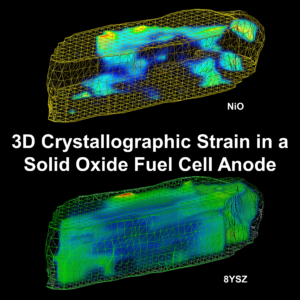
In this work, we combine the latest state-of-the-art X-ray characterization methods from both lab and synchrotron sources to inspect the partial re-oxidation of a Ni/NiO-YSZ anode. Through refinement of the absorption and diffraction data, we present a new insight into the crystal structure developments as a result of this prominent SOFC degradation process. Re-oxidation of the anode can cause substantial performance implications for SOFCs and insight such as this improves our understanding of the complex mechanisms responsible.
It is well known that the re-oxidation of the anode within an SOFC can have significant performance implications due to the lack of electrical conductivity and potentially irreversible structural changes associated with the Ni metal; however, the implications for the ceramic YSZ are often not considered. We explore the crystallography of a partially re-oxidized SOFC anode that emulates the implications of a failed gasket or gas cross-over event.
Benefits:
Although time-resolved studies are possible for lower resolutions, spatially resolved information that is obtained at high resolutions (such as within this work) can provide insight that may be lost at larger imaging scales. However, as imaging facilities are developed, e.g., the advent of fourth generation synchrotrons, acquisition times will reduce, improving temporal resolutions and potentially permitting high-resolution in situ and operando experiments. This would also present the opportunity to monitor the dynamics of individual particles, allowing us to confirm at what exact point strain is formed and whether pre-existing stress influences operational structural changes.
The use of state-of-the-art techniques as well as the new insight gained from them within this work will prove valuable in the understanding of SOFC degradation. Ultimately improving our knowledge of which aspects of the materials degrade during specific processes such as gasket failure will aid us in developing mitigation and prevention strategies that will extend SOFC lifetimes and improve their competitiveness within the mass market.
Further reading:
The Detection of Monoclinic Zirconia and Non-Uniform 3D Crystallographic Strain in a Re-Oxidized Ni-YSZ Solid Oxide Fuel Cell Anode.Thomas M. M. Heenan, Antonis Vamvakeros, Chun Tan, Donal P. Finegan, Sohrab R. Daemi, Simon D. M. Jacques, Andrew M. Beale, Marco Di Michiel, Dan J. L. Brett and Paul R. Shearing, Crystals 2020, 10, 941., https://doi.org/10.3390/cryst10100941