
Case Study: Enabling X-ray diffraction computed tomography (XRD-CT) for large samples
Companies involved:
Finden Ltd, University College London, DESY, Alan A. Coelho, STFC’s SciML
Challenge:
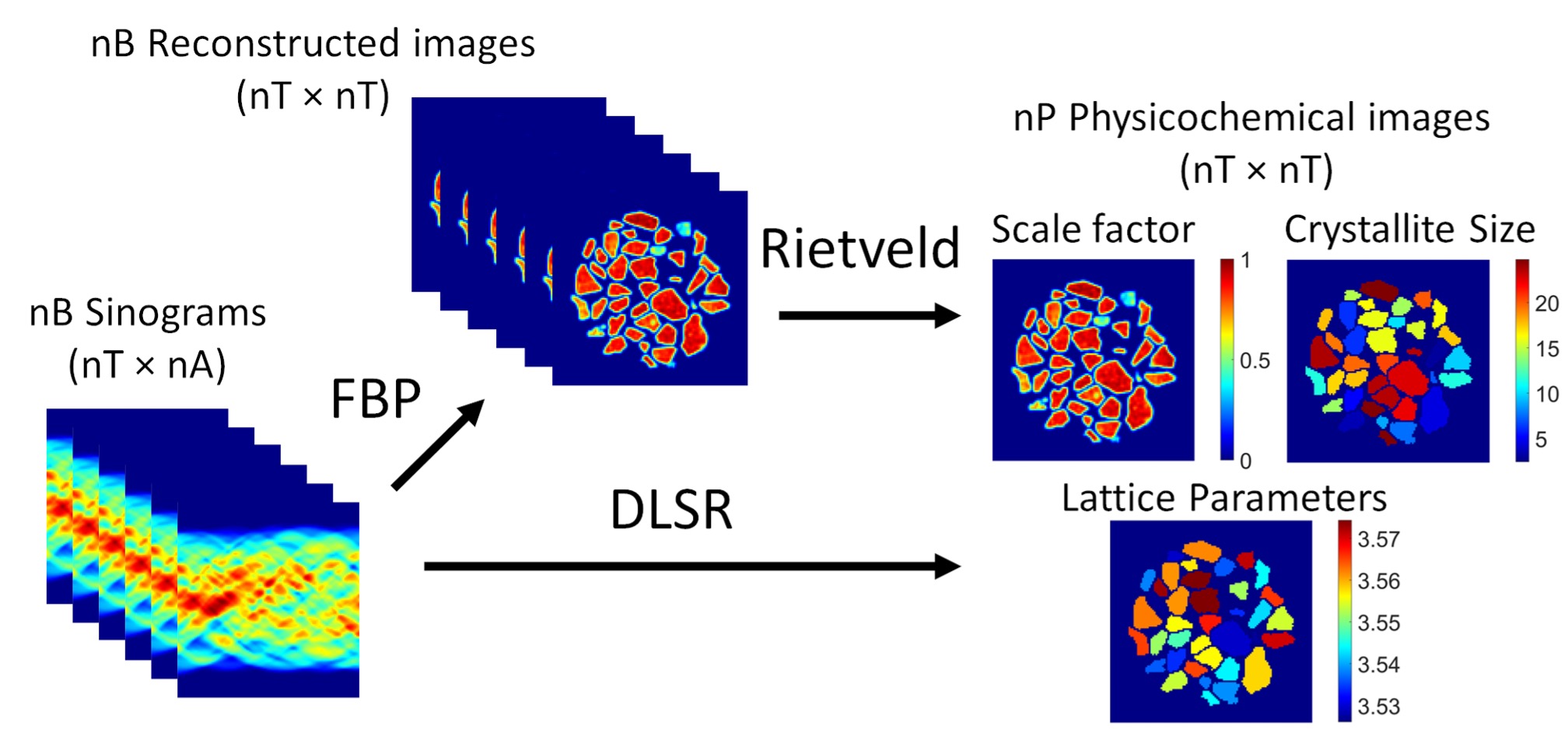
Over the past decade XRD-CT has gained a lot of attraction as a materials characterisation technique that allows for spatially resolving the chemistry inside samples in a non-destructive manner. However, one of the limitations of the technique is related to the sample size due to the parallax artefact. The parallax artefact arises from relatively large samples where X-rays, scattered from a scattering angle 2θ, arrive at multiple detector elements. This phenomenon leads to loss of physico-chemical information associated with diffraction peak shape and position (i.e. altering the calculated crystallite size and lattice parameter values, respectively) and is currently the major barrier to investigating samples and devices at the centimetre level (scale-up problem).
Sample:
Phantom sample consisting of four capillaries containing TiO2, SiC and (2x) MgO powders
Solution:
We have developed a new tomographic reconstruction algorithm, termed Direct Least-Squares Reconstruction (DLSR) algorithm, which solves the parallax artefact problem in XRD-CT. We have demonstrated that our approach works with both simulated and experimental XRD-CT data leading to accurate scale factor/ weight percentage, lattice parameter and crystallite size maps.
Benefits:
It is expected that the new approach will open a new path for X-ray-scattering-based CT techniques and their application to samples that are several centimetres in diameter. Overcoming the parallax barrier is especially important for functional materials and devices, such as catalytic reactors, batteries and fuel cells where the chemistry in idealized cells can vary significantly from their industrial-size counterparts (e.g.different degradation mechanisms taking place at different length scales).
Further reading:
DLSR: a solution to the parallax artefact in X-ray diffraction computed tomography data. Vamvakeros A., Coelho A.A., Matras D., Dong H., Odarchenko Y., Price S.W.T., Butler K.T., Gutowski O., Dippel A.C., von Zimmerman M., Martens I., Drnec J., Beale A.M., Jacques S.D.M., Journal of Applied Crystallography, 54 (6), 2020, DOI: https://doi.org/10.1107/S1600576720013576