
Case Study: Addressing angular undersampling artefacts in computed tomographic images by employing SD2I, a self-supervised image reconstruction algorithm
Companies involved:
Finden Ltd, University College London, DESY, STFC, VITO
Challenge:
Recent advancements in X-ray sources and detectors have led to the collection of rapid time-resolved data from various positions within a sample or sample ensemble through time-resolved imaging/tomography experiments. However, the large volume and fast acquisition of data present challenges for traditional image reconstruction and analysis methods. The current limitations in chemical imaging techniques often arise from the need for dense sampling in sinograms to achieve high-quality image reconstructions. There is a requirement for algorithms that can enhance reconstruction with sparsely sampled sinograms, enabling the attainment of higher levels of spatial and temporal resolution in chemical imaging.
Sample:
Commercial cylindrical 10440 Li-ion NMC532 batteries and 3D printed SrNbO2N photocatalyst
Solution:
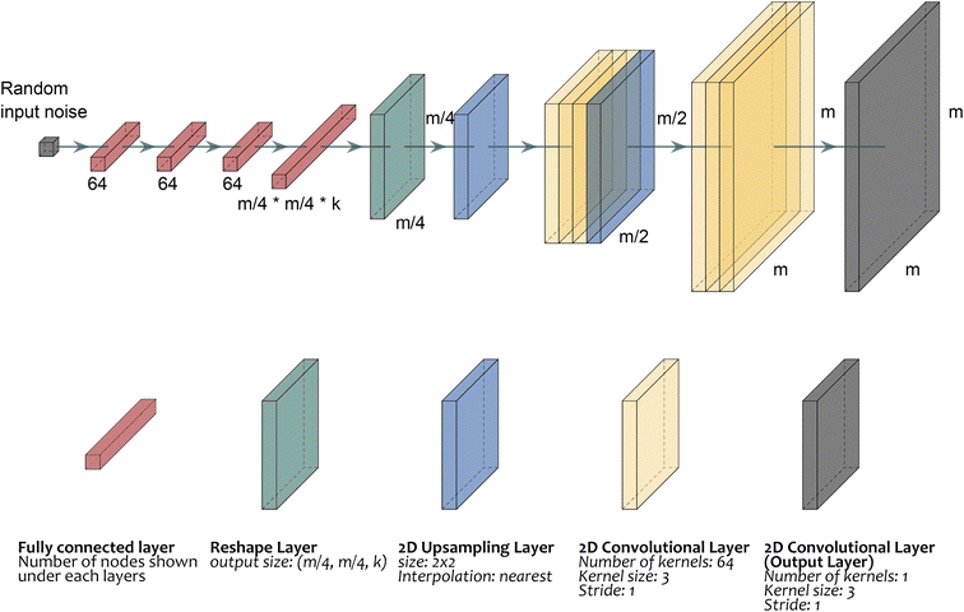
Figure: A representation of the CNN reconstruction SD2I architecture with upsampling (SD2Iu).
We present a lightweight and scalable artificial neural network architecture which is used to reconstruct a tomographic image from a given sinogram. A self-supervised learning approach is used where the network iteratively generates an image that is then converted into a sinogram using the Radon transform; this new sinogram is then compared with the sinogram from the experimental dataset using a combined mean absolute error and structural similarity index measure loss function to update the weights of the network accordingly. We demonstrate that the network is able to reconstruct images that are larger than 1024 × 1024. Furthermore, it is shown that the new network is able to reconstruct images of higher quality than conventional reconstruction algorithms, such as the filtered back projection and iterative algorithms (SART, SIRT, CGLS), when sinograms with angular undersampling are used. The network is tested with simulated data as well as experimental synchrotron X-ray micro-tomography and X-ray diffraction computed tomography data.
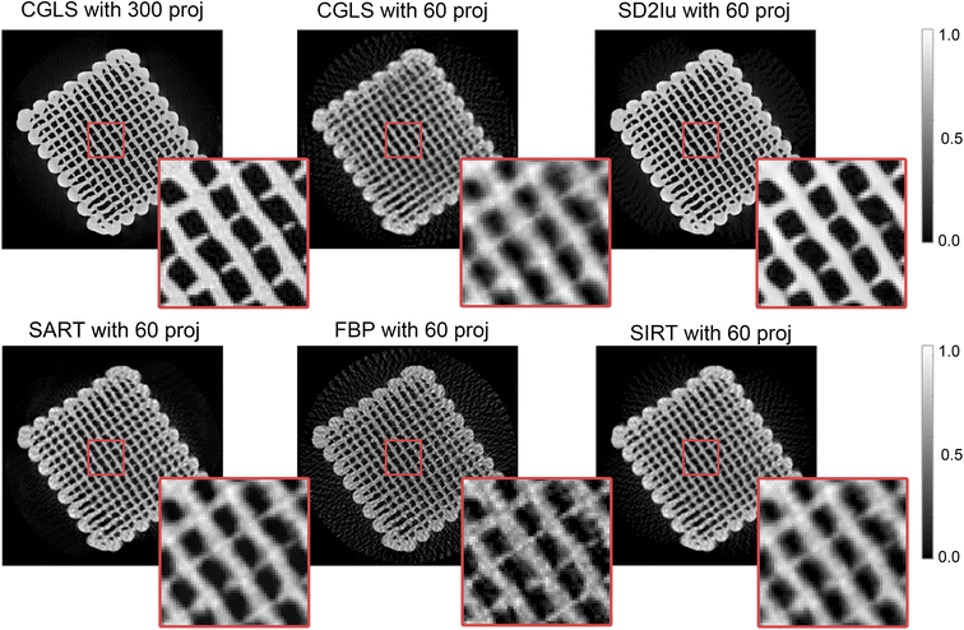
Figure: Photocatalyst XRD-CT image reconstruction using various methods
Benefits:
The new architecture offers several advantages, including scalability through the reduction of parameters, suppression of angular undersampling artefacts, preservation of absolute intensities in images, ease of use with minimal hyperparameter tuning, and simplicity without the need for a discriminator network. The code can be run by a non-expert and does not require multiple hyperparameter tuning in contrast to other conventional methods (e.g. SART/SIRT/CGLS as well as regularisation-based methods). It demonstrates the potential for accurately reconstructing images from sparsely-sampled sinograms, making it valuable for time-resolved experiments and reducing X-ray doses in medical CT. The network could potentially be applied to other tomographic methods and modalities, and it may also find application in addressing other imaging inverse problems, such as the parallax problem in XRD-CT.
Further reading:
A scalable neural network architecture for self-supervised tomographic image reconstruction. Dong H., Jacques S.D.M., Kockelmann W., Price S., Emberson R., Matras D., Odarchenko Y., Middelkoop V., Giokaris A., Gutowski O., Dippel A.-C., von Zimmermann M., Beale A.M., Butler K., Vamvakeros, A., Digital Discovery. 2023, DOI: https://doi.org/10.1039/D2DD00105E
Read more about our team and further publications.