
First chemical imaging study on 3D printed catalysts used for CO2 methanation
Finden scientists new work on the characterisation on 3D printed catalysts has been published in a new paper, “3D printed Ni/Al2O3 based catalysts for CO2 methanation – a comparative and operando XRD-CT study” in the Journal of CO2 Utilization. The X-ray chemical imaging work was performed with Vesna Middelkoop from the Flemish Institute for Technological Research (VITO) using ESRF’s ID15A beamline.
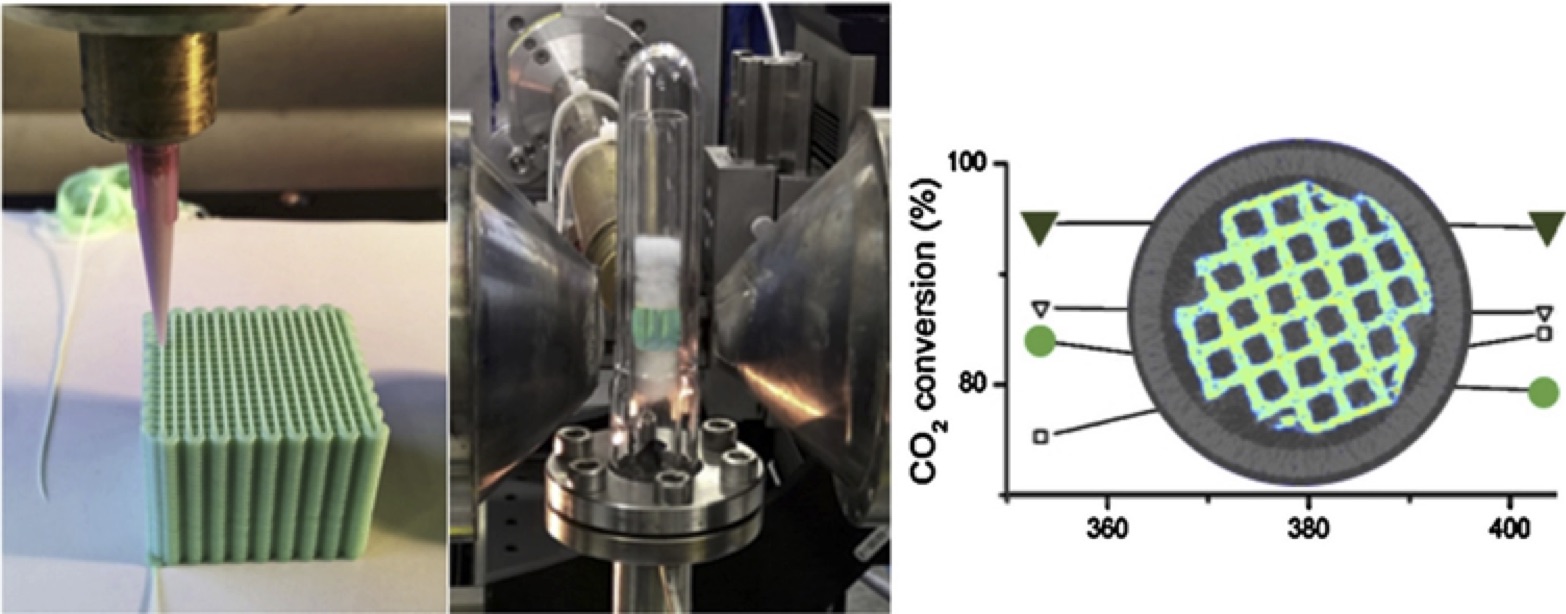
Ni-alumina-based catalysts were directly 3D printed into highly adaptable monolithic/multi-channel systems and evaluated for CO2 methanation. By employing emerging 3D printing technologies for catalytic reactor design such as 3D fibre deposition (also referred to as direct write or microextrusion), we developed optimised techniques for tailoring both the support’s macro- and microstructure, as well as its active particle precursor distribution. A comparison was made between 3D printed commercial catalysts, Ni-alumina based catalysts and their conventional counterpart, packed beds of beads and pellet. Excellent CO2 conversions and selectivity to methane were achieved for the 3D printed commercial catalyst (95.75% and 95.63% respectively) with stability of over 100 h. The structure-activity relationship of both the commercial and in-house 3D printed catalysts was explored under typical conditions for CO2 hydrogenation to CH4, using operando ‘chemical imaging’, namely X-Ray Diffraction Computed Tomography (XRD-CT). The 3D printed commercial catalyst showed a more homogenous distribution of the active Ni species compared to the in-house prepared catalyst. For the first time, the results from these comparative characterisation studies gave detailed insight into the fidelity of the direct printing method, revealing the spatial variation in physico-chemical properties (such as phase and size) under operating conditions.
Institute for Technological Research (VITO), Ghent University, University Colleges Leuven-Limburg, Grenoble Alpes University and University College London.
Read the article at https://www.sciencedirect.com/science/article/pii/S2212982019303063