
Our paper on the first X-ray diffraction tomography experiment of real-life size micro-tubular SOFC has been published in Nature Communications
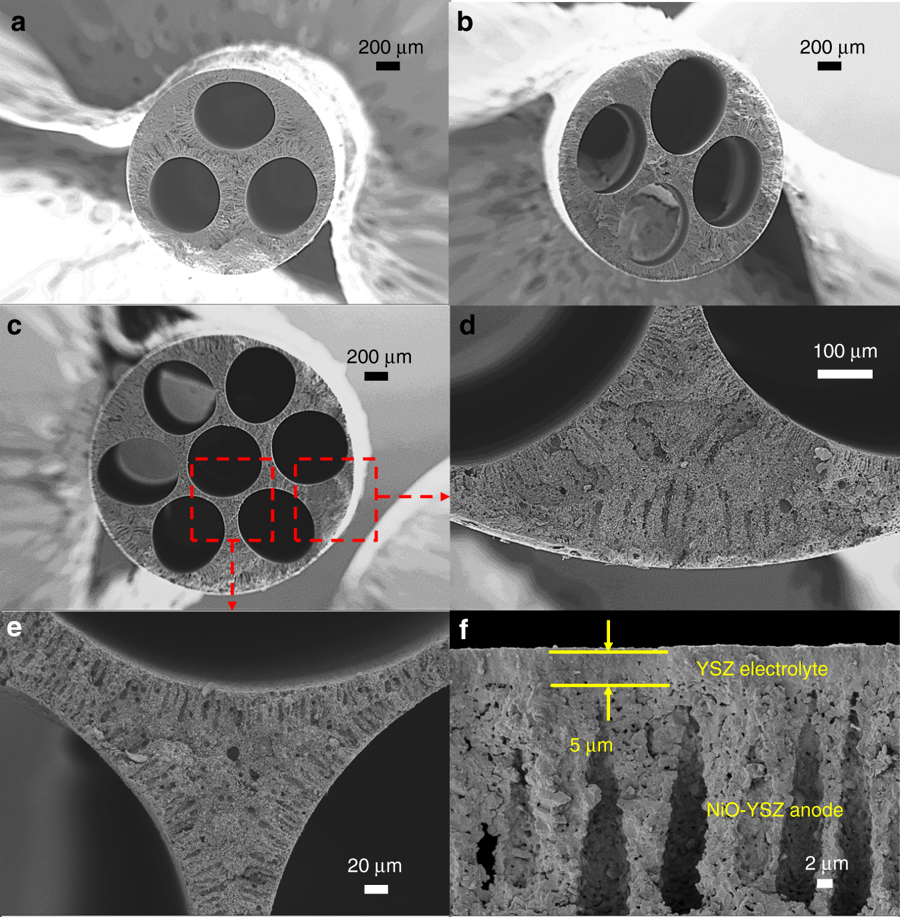
Various micro-monolithic anode supports after sintering at 1450 °C. SEM images of central-axis-view of: a 3, b 4, and c 7 channels; Cross-sectional images of d sponge between the shell and two channels in the 7-channel anode, e sponge between the central channel and surrounding two channels in the 7-channel anode; f close-up image of anode/electrolyte interface
Our new work on a state-of-the-art SOFC has been published in a paper “Design of next-generation ceramic fuel cells and real-time characterization with synchrotron X-ray diffraction computed tomography“ in Nature Communications.
Solid oxide fuel cells offer a clean and efficient means of producing electricity through a variety of fuels. However, miniaturization of cell dimensions for portable device applications remains a challenge, as volumetric power densities generated by readily-available planar/tubular ceramic cells are limited. In our work, we demonstrate a concept of ‘micro-monolithic’ ceramic cell design and evaluate the mechanical robustness and structural integrity of this design, for the first time, with synchrotron X-ray diffraction computed tomography. The successful miniaturization results in an exceptional power density of 1.27 W cm−2 at 800 °C, which is among the highest reported. This holistic design incorporates both mechanical integrity and electrochemical performance, leading to mechanical property enhancement and representing an important step toward commercial development of portable ceramic devices with high volumetric power (>10 W cm−3), fast thermal cycling and marked mechanical reliability. This is also the first time a real-life size solid oxide fuel cell has been investigated in situ demonstrating that such experiments are now possible, adding a very powerful characterisation tool for the SOFC community in general.
The synchrotron experiments were conceived, designed and performed by Dr Antony Vamvakeros and Dorota Matras in collaboration with a team from the Electrochemical Innovation Lab (EIL) from UCL Chemical Engineering using ESRF’s ID15A beamline using a state-of-the-art SOFC designed by Imperial College.
Read the full article at https://www.nature.com/articles/s41467-019-09427-z
Read more about it at http://www.esrf.eu/sites/www/home/news/general/content-news/general/real-time-characterisation-of-a-new-miniature-honeycomb-fuel-cell-shows-its-outstanding-properties.html